
Risk Management in the North American Metal Wholesale Industry
A Strategic Framework for Service Centers and Distributors
Executive Summary
North American metal service centers and distributors operate in one of the most risk-intensive segments of the supply chain. A single pricing miscalculation during a commodity swing can erase an entire month’s profit margin. A customer default on $45,000 can wipe out profit equivalent to $500,000 in new sales. An undocumented inventory adjustment or unauthorized pricing override exposes the business to fraud, theft, and audit failures.
This white paper examines three critical risk categories that define financial performance in metal wholesale:
- Inventory and Metal Price Volatility Risk – Managing commodity price exposure, inventory valuation challenges, and slow-moving stock
- Credit and Customer Risk – Preventing payment defaults, managing accounts receivable aging, and controlling customer concentration
- Auditability and Traceability – Establishing internal controls, maintaining compliance-ready audit trails, and preventing unauthorized transactions
Modern ERP and specialized metal distribution software systems provide systematic mitigation through automated repricing tied to commodity indices, payment behavior analytics, approval workflows, and immutable audit trails. Organizations implementing industry-specific controls achieve 50-70% better risk mitigation effectiveness compared to manual processes, translating to higher margins, lower bad debt write-offs, and reduced fraud exposure.
Understanding Risk in Metal Distribution
Metal distribution differs fundamentally from traditional wholesale operations. Distributors combine inventory-heavy capital requirements with extreme commodity price volatility, extended credit cycles tied to construction project cash flows, and high-value transactions requiring strict internal controls.
In an industry where net margins typically run 3-8%, effective risk management determines whether a business sustains profitability or faces financial distress. The question is not whether these risks exist—they are unavoidable industry characteristics—but whether they are systematically managed or left to chance.
Risk Category 1: Inventory and Metal Price Volatility
The Challenge
Steel, aluminum, and specialty alloy prices fluctuate daily based on global supply-demand dynamics, raw material costs, tariffs, and geopolitical events. A distributor who purchases hot-rolled coil at $650 per ton may find replacement cost at $720 per ton within 30 days—yet customer pricing agreements often lock in rates for 60-90 days.
This creates multiple exposures:
- Replacement cost risk: Inventory purchased at one price must be sold profitably when replacement costs have changed significantly
- Contract exposure: Fixed-price contracts signed before a commodity run-up transfer all cost increases to the distributor
- Slow-moving inventory (SLOB): Specialty grades or over-ordered material become financial dead weight if commodity prices decline
Industry data shows a 20% steel cost increase without adequate price escalation clauses can wipe out an entire account’s annual profit. For a service center carrying $5 million in inventory, a 10% price swing represents $500,000 in balance sheet impact.
Software-Enabled Mitigation
Manual price sheets updated every 2-4 weeks create margin erosion during volatile periods. Industry-specific software provides real-time protection:
- Automated price updates tied to commodity index feeds (CRU, AMM, Platts) trigger repricing within 24 hours of >2% index movement
- Real-time margin visibility on every quote, calculated using replacement cost rather than historical cost
- Formalized surcharge schedules tied to published indices and removed from sales rep negotiation authority
- Index-linked contract escalation clauses automatically adjust pricing outside negotiated bands
Distributors implementing these controls reduce inventory valuation risk by 50-65% and maintain 18-20% margins during commodity surges versus 8-12% for competitors using manual processes
Risk Category 2: Credit and Customer Risk
The Challenge
Credit risk in metal wholesale is uniquely complex because the largest customer segment—construction contractors—operates on project-based cash flow. Payment depends on upstream approvals from general contractors and lenders. A contractor who is 45 days past due may not be in financial distress; they may simply be awaiting a construction draw.
This creates critical judgment challenges: holding shipments too aggressively damages relationships and delays customer projects; waiting too long risks write-offs.
The financial impact of bad debt is severe due to the multiplier effect:
- For a distributor operating on 10% margins, a $50,000 unpaid invoice requires $500,000 in new revenue to replace the lost profit
- Industry bad debt rates range from 1-5% of revenue depending on customer mix
- Collection probability decays rapidly: 85% at 30 days past due, only 50% at 90 days, less than 25% at 180 days
For distributors with $2-10 million in receivables, even a 10-day increase in Days Sales Outstanding (DSO) traps $500,000+ in working capital.
Software-Enabled Mitigation
Modern credit and collections management moves beyond static aging reports to provide context-rich, proactive risk controls:
- Integrated credit scoring with real-time API connections to D&B, Experian, and trade credit bureaus produces automated approval/decline decisions
- Dynamic credit limits adjust continuously based on payment velocity changes, negative news sentiment, and trade credit data
- Payment history overlays on AR aging reports show customer payment norms versus current aging, enabling collaborative rather than accusatory collections conversations
- Tiered dunning workflows differentiate collection cadence by customer risk profile—high-value reliable customers receive different treatment than high-risk slow-payers
- Concentration risk monitoring alerts when single customers exceed 15% of total AR exposure
Service centers implementing structured processes see DSO improvements of 5-12 days within six months, representing $500,000 to $1.2 million in freed working capital. Credit-related bad debt decreases by 15-25% through earlier identification and faster intervention.
Risk Category 3: Auditability and Traceability
The Challenge
Metal distributors face unique audit and compliance pressures due to high-value transactions, frequent pricing adjustments, and complex inventory movements. A single unauthorized pricing override on a $100,000 steel order or an undocumented inventory adjustment can represent significant fraud exposure.
According to audit industry data, 80% of fraud cases involve breakdowns in internal controls. In distribution, 45% of pricing transactions show inconsistencies without proper approval workflows and audit trails.
Audit trails—chronological records answering “who did what, when, and from where”—are essential for:
- Fraud prevention and error detection
- Regulatory compliance (SOX, GDPR)
- Data integrity and financial accuracy
- Customer/vendor dispute resolution
Critical Control Points
Four transaction types demand complete auditability in metal distribution:
1. Pricing Overrides and Discounts Uncontrolled price overrides destroy margins. Sales reps facing urgent customer demands may discount below cost without understanding impact. Software controls include:
- Approval workflows based on discount depth (0-5% rep authority, 5-10% manager approval, >10% VP required)
- Margin impact analysis displayed before override submission
- Immutable audit log recording user, timestamp, justification, and approver
- Daily exception reporting of below-floor pricing
Implementation reduces unauthorized discounts by 75-82%.
2. Inventory Adjustments Write-offs, quantity changes, and location transfers represent high fraud risk if not controlled. Required controls:
- Segregation of duties—users who adjust cannot approve their own changes
- Approval thresholds for adjustments >$5,000 or >5% variance
- Full audit trail with before/after quantities, reason codes, and evidence
Proper controls decrease unauthorized adjustments by 68-74%.
3. Credit Limit Changes Sales reps unilaterally increasing limits or extending payment terms create default risk. Controls include:
- Approval workflow based on credit score, payment history, and increase amount
- Automatic credit hold enforcement when balance exceeds limits
- Complete change history with justification and approver
- Quarterly recertification requiring credit manager sign-off on limits >$50K
Credit approval controls reduce credit-related losses by 60-70%.
4. Vendor Payments Vendor payment fraud—duplicate payments, inflated amounts, fictitious vendors—represents significant risk. Essential controls:
- Three-way match requirement (PO, receiving document, invoice)
- Segregation of duties preventing users from both creating vendors and approving payments
- Dual approval for new vendor additions and bank account changes
- Payment approval thresholds (>$25K manager, >$100K controller)
Distributors with proper payment controls reduce vendor payment fraud by 78-85%.
Technical Requirements for Effective Audit Trails
For audit trails to provide meaningful protection, they must meet strict standards:
- Immutability: Write-once storage with cryptographic hashing; trails that can be altered are worthless
- Completeness: Log all master data changes, financial transactions, configuration changes, access modifications
- Tamper-proof security: Access restricted to auditors; separate credentials; offsite backup
- Retention compliance: SOC requires 7-year retention; automated archival policies
Modern ERP systems with built-in audit controls reduce compliance audit preparation time by 60-75% compared to reconstructing logs from multiple systems.
Integrated Risk Management: Comparing Approaches
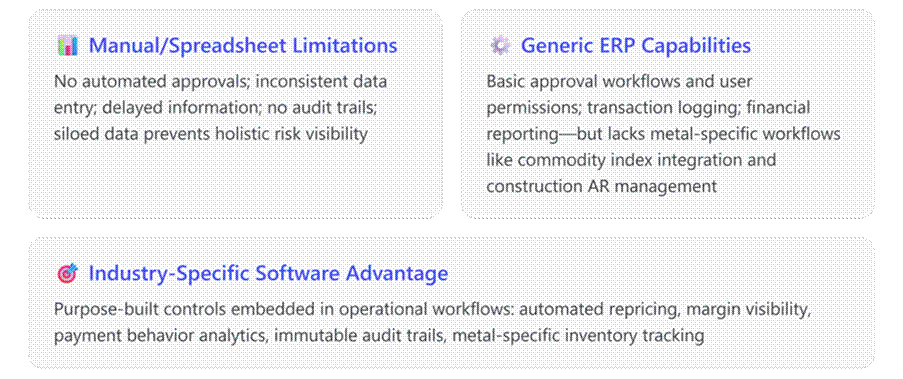
The following table maps key risks to their operational impacts and software-based mitigation approaches:
| Risk Exposure | Operational Impact | Software-Enabled Mitigation | Effectiveness |
| Lagging commodity price updates | Margin erosion during volatile periods; price sheets manually updated every 2-4 weeks | Automated price updates tied to CRU/AMM/Platts indices; repricing triggered within 24 hours of >2% movement | 50-65% reduction in valuation risk |
| Inconsistent surcharge application | Sales reps negotiate away surcharges; 1-3% revenue leakage | Formalized surcharge schedules tied to published indices; removed from rep authority | Preserves 1-3% revenue |
| Payment behavior deterioration | Customer defaults undetected until 60+ days past due; $500K in new sales needed to replace $50K bad debt | Payment velocity alerts flag statistical anomalies; dynamic credit limits adjust exposure | 15-25% reduction in bad debt |
| DSO creep | 10-day DSO increase traps $500K-$1M in working capital | Tiered dunning automation by customer risk profile; context-rich AR aging | 5-12 day DSO improvement; $500K-$1.2M freed capital |
| Unauthorized pricing overrides | Sales reps discount below cost; undiscovered until monthly close; margin leakage | Approval workflows by discount depth; margin impact display; daily exception reports | 75-82% reduction in unauthorized discounts![1] |
| Inventory adjustment fraud | Undocumented write-offs hide theft or diversion; internal control failures | Segregation of duties; approval thresholds; immutable audit logs | 68-74% decrease in unauthorized adjustments |
| Vendor payment fraud | Duplicate payments; fictitious vendors; kickback schemes | Three-way match requirement; dual approval for vendor changes; SoD enforcement | 78-85% reduction in payment fraud |
Implementation Roadmap
Software Selection Criteria
When evaluating metal distribution software, assess risk management capabilities across three dimensions:
Inventory & Price Risk Controls: Commodity index integration (CRU, AMM, Platts) ✓ Real-time margin calculation using replacement cost ✓ Automated SLOB detection ✓
Credit & Customer Risk Controls: Integrated credit scoring (D&B, Experian APIs) ✓ Payment history overlays on AR aging ✓ Tiered dunning automation ✓ Concentration risk monitoring ✓ Dynamic credit limit adjustment
Audit & Compliance Controls: Immutable audit trails for all transactions ✓ Configurable approval workflows ✓ Segregation of duties enforcement ✓ Exception reporting dashboards ✓ SOC/GDPR-compliant retention
Measuring Effectiveness
Track leading and lagging indicators to validate control effectiveness:
Inventory & Price Risk: Monitor % of quotes with <15% margin, price update lag time, SLOB as % of total inventory (leading); measure gross margin %, inventory turns, obsolescence write-offs (lagging)
Credit & Customer Risk: Track % of accounts >45 days past due, credit limit exceptions per week, AR concentration >15% (leading); measure DSO days, bad debt as % of revenue, collection rate (lagging)
Audit & Compliance: Monitor unauthorized override attempts per week, SoD conflicts detected, audit findings per quarter (leading); measure audit preparation hours, regulatory penalties, internal fraud incidents (lagging)
Organizations that systematically measure and manage these metrics achieve 15-25% reduction in total risk-related losses within 12 months.
Conclusion: Risk Management as Competitive Advantage
Commodity price swings, extended credit cycles, and operational complexity are unavoidable characteristics of metal distribution. Manual processes and generic ERP systems provide foundational controls but leave critical gaps: pricing decisions made without real-time margin visibility, credit extended without understanding payment trends, transactions approved without proper authority or audit trails.
Industry-specific software transforms risk management from reactive to proactive through automated repricing, payment behavior analysis, approval workflows, and immutable transaction logs. The result: distributors achieve 50-70% better risk mitigation effectiveness, translating to higher margins, lower bad debt write-offs, faster compliance audits, and reduced fraud exposure.
Risk management is not a cost center—it is a profit protection strategy. Every percentage point of margin preserved through better pricing controls, every customer default prevented through early intervention, every compliance penalty avoided through proper audit trails contributes directly to bottom-line profitability. In an industry where net margins often run 3-8%, effective risk management can be the difference between sustained profitability and financial distress.
About This White Paper
This guide synthesizes industry best practices, operational data, and compliance requirements specific to North American metal service centers and distributors. It is designed as an educational resource for operations leaders, CFOs, and business owners seeking to systematically mitigate operational risks. Specialized metal distribution software platforms—such as Micro Metal Software and similar industry-focused systems—provide purpose-built tools for inventory visibility, credit automation, and compliance-ready audit trails that enable the risk management framework outlined in this paper.

Recent Posts
About Micro
Micro Metal Software provides powerful ERP, inventory management, ecommerce, and operations software built specifically for the metal industry. Designed for steel service centers, metal distributors, processors, and fabricators, our platform helps companies manage inventory, purchasing, sales, production, quoting, order fulfillment, and online customer portals from one connected system. With industry-specific tools for metal stock control, traceability, pricing, and distribution workflows, Micro Metal Software helps metal businesses streamline operations, improve visibility, reduce manual work, and scale with confidence.
Learn More