
Credit Card Surcharges for Metal Distributors: Hidden Costs & ERP Tracking
Hidden Costs, Margin Impact, and How ERP Software Helps Track Them
For metal distributors, profitability is rarely lost all at once.
It disappears slowly through:
- excess inventory,
- inefficient purchasing,
- operational blind spots,
- and hidden transaction costs.
One of the most overlooked examples?
Credit card processing fees and surcharges.
For many steel service centers, fabrication shops, and metal suppliers, these costs quietly reduce margins on every transaction. And because the fees are often buried inside accounting statements instead of operational reporting, many businesses underestimate their true impact.
Modern ERP software changes that by connecting payment activity directly to:
- inventory,
- sales orders,
- customer profitability,
- and operational reporting.
The result is better visibility, smarter financial decisions, and stronger margin control.
Why Credit Card Fees Matter More in Metal Distribution
Most industries process relatively small transactions.
Metal distributors do not.
A single order for:
- steel plate,
- aluminum tubing,
- stainless inventory,
- or fabrication materials
…can easily reach thousands — or even hundreds of thousands — of dollars.
That means even small processing percentages create significant operational costs.
Example Processing Costs
| Annual Card Volume | Avg Processing Fee | Estimated Annual Cost |
|---|---|---|
| $500,000 | 2.9% | $14,500 |
| $1,000,000 | 2.9% | $29,000 |
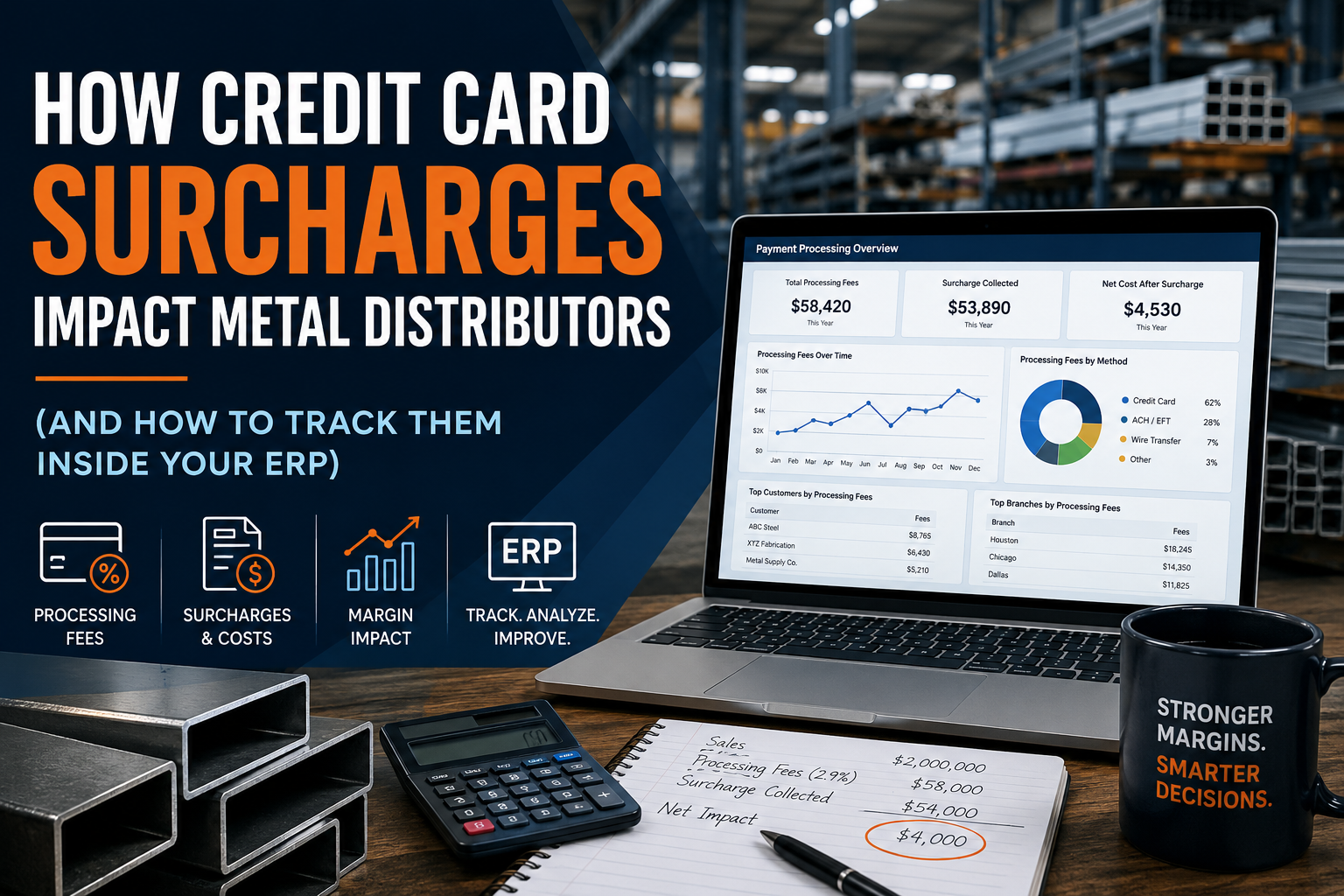
| $2,000,000 | 2.9% | $58,000 |
| $5,000,000 | 2.9% | $145,000 |
For many distributors, these costs rival:
- software expenses,
- warehouse overhead,
- equipment leases,
- or staffing costs.
Yet many companies still treat them as background noise instead of measurable operational leakage.
What Is a Credit Card Surcharge?
A credit card surcharge is an additional fee added to a transaction to offset merchant processing costs charged by payment providers.
Instead of absorbing the fee internally, businesses pass some or all of the processing expense to the customer.
Surcharge programs have become increasingly common as businesses face rising:
- operational expenses,
- inventory carrying costs,
- freight costs,
- and financing rates.
However, surcharge programs only work effectively when businesses can properly track:
- processing costs,
- customer behavior,
- and profitability trends.
That’s where ERP visibility becomes essential.
The Hidden Problem Most Distributors Don’t See
Most accounting systems can tell you:
“You paid $48,000 in processing fees last year.”
But they usually cannot tell you:
- which customers created the highest costs,
- which branches process the most card transactions,
- whether surcharge programs are recovering enough margin,
- or how payment methods impact profitability.
Without operational visibility, distributors are often making decisions based on assumptions instead of data.
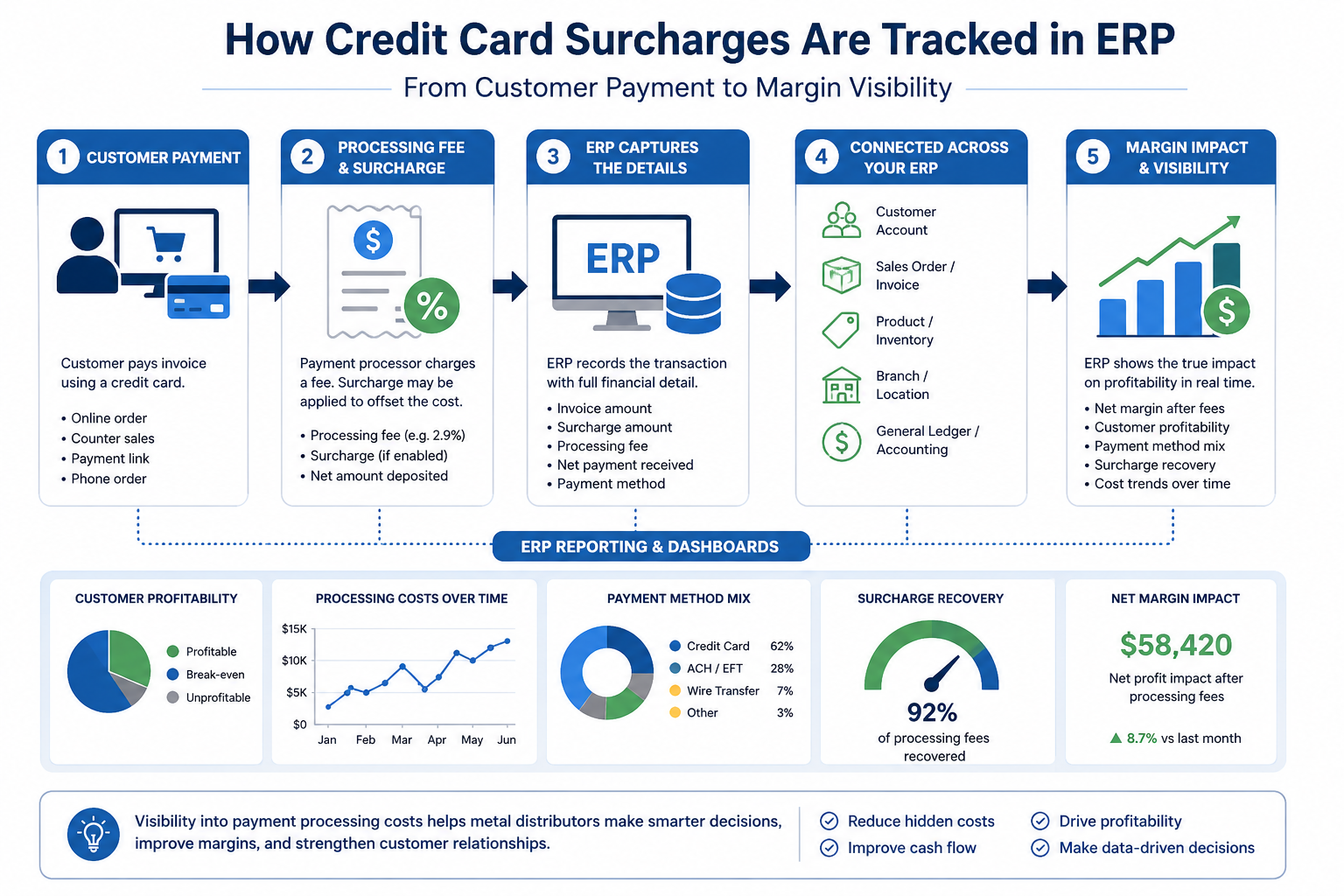
How ERP Software Helps Track Credit Card Surcharges
Modern ERP software for metal distributors does more than manage inventory and sales orders.
It connects financial activity directly to operational reporting.
That means payment processing data becomes visible across the business.
1. Customer Profitability Analysis
Not all customers generate the same profit.
A customer with high sales volume may actually produce weaker margins if they consistently pay using high-fee payment methods.
ERP systems can help track:
- customer-level processing costs,
- payment behavior trends,
- surcharge recovery rates,
- and net profitability after transaction fees.
This gives distributors the ability to:
- encourage ACH or wire payments,
- adjust account strategies,
- or restructure payment policies for large-volume buyers.
2. Invoice-Level Fee Tracking
Traditional accounting reports often summarize merchant fees into a single monthly expense line.
ERP systems provide much deeper visibility by connecting fees directly to:
- invoices,
- sales orders,
- customers,
- warehouse locations,
- and product categories.
This allows businesses to understand:
- actual net profit per order,
- true margin after fees,
- and where operational leakage is occurring.
For metal service centers operating on tight margins, this level of visibility matters.
3. Real-Time Margin Visibility
Without ERP reporting, many distributors only discover processing costs during month-end reconciliation.
Modern ERP systems allow businesses to identify margin erosion in real time.
That means leadership teams can quickly answer questions like:
- Are online orders generating higher processing costs?
- Are surcharge programs effective?
- Should large accounts move to ACH terms?
- Which transaction types create the most operational expense?
Instead of reacting after the fact, businesses gain the ability to proactively manage profitability.
Why This Matters in 2026
Operational costs continue to rise across the distribution industry.
Metal distributors are facing pressure from:
- higher inventory carrying costs,
- increased financing expenses,
- freight volatility,
- labor shortages,
- and tighter margins.
At the same time, customers expect:
- faster fulfillment,
- digital ordering,
- online payments,
- and seamless purchasing experiences.
That means distributors can no longer afford operational blind spots.
The businesses that succeed are the ones that understand:
- where profit is generated,
- where margin is lost,
- and how operational costs impact every transaction.
ERP Visibility Creates Better Operational Decisions
The goal is not simply to charge customers more.
The goal is visibility.
When ERP systems connect:
- inventory,
- purchasing,
- accounting,
- payment activity,
- and customer reporting,
…businesses gain a much clearer understanding of operational performance.
This allows distributors to:
- reduce unnecessary costs,
- improve cash flow,
- identify unprofitable transaction patterns,
- and make data-driven financial decisions.
For many metal distributors, this becomes a competitive advantage.
Payment Processing Workflow Example
Imagine a customer purchases:
- $18,000 in aluminum inventory
- using a rewards credit card with a 3.1% processing fee
Without ERP visibility:
- the sale appears profitable,
- but the processing fee quietly reduces actual margin.
With ERP-connected reporting:
- the processing fee becomes attached to the invoice,
- profitability updates in real time,
- and leadership gains accurate operational reporting.
This creates far better financial awareness across the organization.
Frequently Asked Questions
What is a credit card surcharge?
A credit card surcharge is an additional fee added to customer transactions to offset merchant processing costs charged by payment providers.
Are credit card surcharges legal?
Credit card surcharge laws vary by state and payment network. Businesses should consult legal advisors and payment processors before implementing surcharge programs.
How much do credit card processing fees cost businesses?
Most businesses pay between 1.5% and 3.5% per transaction depending on:
- card type,
- processor agreements,
- transaction methods,
- and payment networks.
Can ERP software track processing fees?
Yes. Modern ERP software can associate payment processing costs with:
- invoices,
- customers,
- sales orders,
- and operational reporting dashboards.
Why do processing fees matter for metal distributors?
Metal distributors often process large-ticket transactions where even small percentage fees can significantly reduce profitability.
Should distributors encourage ACH payments?
Many distributors encourage ACH or wire payments for high-value invoices because they typically carry lower transaction costs than credit card payments.
Final Thoughts
Credit card processing fees may appear small on individual invoices.
But across an entire distribution operation, they can quietly erode tens — or even hundreds — of thousands of dollars in margin over time.
Modern ERP systems help metal distributors move beyond guesswork by:
- tracking operational costs in real time,
- connecting payment activity to profitability,
- and providing visibility into the true cost of every transaction.
Because in metal distribution, profitability is not just about selling more inventory.
It’s about understanding the real cost of moving it.

Recent Posts
About Micro
Micro Manage Software stands out as a comprehensive solution offering omnichannel capabilities to not only customers but vendors. Our cutting edge solutions include vendors in the omnichannel, revolutionizing best practices and setting new standards of operations.
Learn More