
Reducing Capital Costs in Metal Distribution: How Inventory Optimization Drives Profit
Executive Summary
Modern metal distributors often have millions of dollars tied up in stock, incurring significant “hidden” capital costs. Inventory carrying costs – which include the cost of capital, storage, insurance, and obsolescence – typically run 20–30% of inventory value per year. In other words, a $10 million steel inventory can quietly cost $2–3 million annually just to hold. This white paper explains how optimizing inventory management can dramatically reduce those capital costs by 15–25% while maintaining customer service levels around 95–99%. Key insights include:
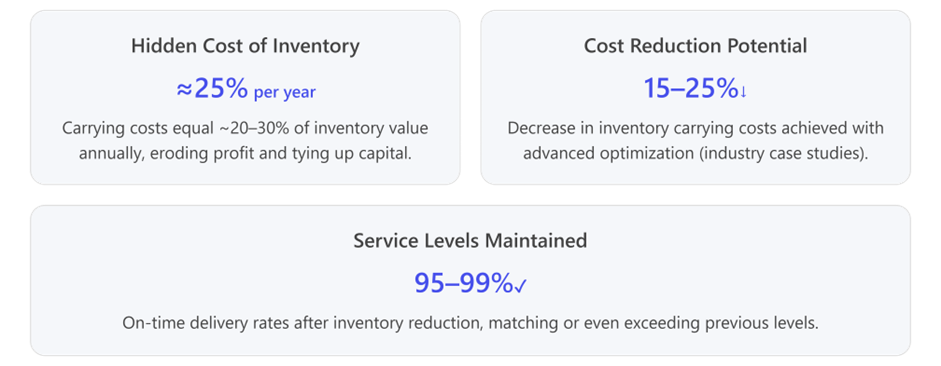
The Challenge: Inventory is a necessary asset for metal distributors but also a major source of unseen costs. Every dollar tied up in slow-moving stock is a dollar not invested elsewhere. Many firms don’t realize that carrying costs (financing, warehousing, insurance, obsolescence) can total a quarter of the inventory’s value annually. This “hidden tax” on inventory directly impacts cash flow and profitability.
Key Insight: Leading distributors are tackling this challenge by optimizing inventory management. By using better forecasting, data-driven stocking policies, and specialized software, they are cutting excess stock and freeing up hundreds of thousands to millions of dollars in working capital without compromising customer service.
The Payoff: Intelligent inventory optimization typically reduces carrying costs by 15–25%, improving EBITDA and cash flow. In one case, a metals supplier saved $2 million in carrying costs after improving inventory processes, money they reinvested in new equipment and growth initiatives. At the same time, these companies maintain >95% fill rates and on-time deliveries, turning inventory management into a competitive advantage rather than a cost center.
Next Steps: This white paper provides a roadmap for reducing capital costs through inventory optimization. We outline current industry challenges, proven strategies (with real case results), and recommended actions. By following these practices – and leveraging tools like Micro Metal’s inventory optimization software – metal distributors can unlock significant cost savings and strengthen their financial performance. For a personalized assessment of your inventory savings potential, please contact Micro Metal.
Introduction
For metal distributors and service centers, inventory is both your lifeblood and your biggest liability. You need stock on hand to meet customer demand, but carrying too much of it can quietly drain your finances. The capital costs tied up in inventory – including the cost of money, storage space, insurance, and depreciation – often go unnoticed on income statements. Yet, these costs are very real. Studies show carrying inventory can cost roughly 25% of its value every year. In practical terms, if you hold $10 million in steel or aluminum products, you might be spending $2.5 million annually just to store and finance that metal.
Why does this matter now? In today’s environment, metal prices and demand are volatile, interest rates have risen (increasing the cost of capital), and supply chains are evolving. Distributors that continue to operate with bloated inventory are leaving money on the table and risking their agility. Meanwhile, those who optimize inventory stand to free up significant cash, improve profit margins, and invest savings into strategic growth (new equipment, technology, or market expansion). In short, optimizing inventory management has emerged as a major competitive advantage.
This white paper explores how metal distribution companies can reduce the capital costs associated with inventory, without sacrificing customer service. We’ll quantify the hidden costs of holding inventory, examine strategies that leading firms are using to slash those costs, and present a roadmap for implementing inventory optimization in your organization. Real-world examples will illustrate the potential ROI – such as a 15–25% reduction in carrying costs and improved on-time delivery to ~98% – demonstrating that better inventory management is not just an operational tweak, but a strategic lever for profitability and cash flow.
The Hidden Cost of Excess Inventory
Inventory = Money on the Shelf. Every piece of metal sitting in your warehouse or yard represents cash that’s not being used elsewhere. The inventory carrying cost is the annual price of holding that inventory – and it encompasses several components: the cost of capital (interest or opportunity cost of tied-up money), storage and handling expenses (warehouse space, labor, equipment), insurance and taxes, and the risk that inventory becomes obsolete or loses value over time. Taken together, these costs typically range from 20–30% of the inventory’s book value per year. They are often called “hidden” costs because they’re not always tracked explicitly in accounting systems; instead, they manifest as reduced liquidity, higher operating expenses, and lower profit margins.
Example: Consider a distributor carrying an average of $10 million in metal inventory. If their carrying cost is 25% (around the industry midpoint), they’re effectively spending $2.5 million a year to hold that inventory. Where does that money go? Figure 1 breaks down the typical components of carrying cost for such an example:
As shown in the chart below, roughly 40% of carrying cost is the cost of capital (interest on borrowed funds or the return that invested cash could have earned). About one-third goes to storage and handling (warehousing space, personnel, equipment maintenance). Another ~20% is lost to risk factors like damage, theft, or material becoming outdated (especially concerning in metals where prices can fall). The remaining share covers service costs such as insurance and taxes.
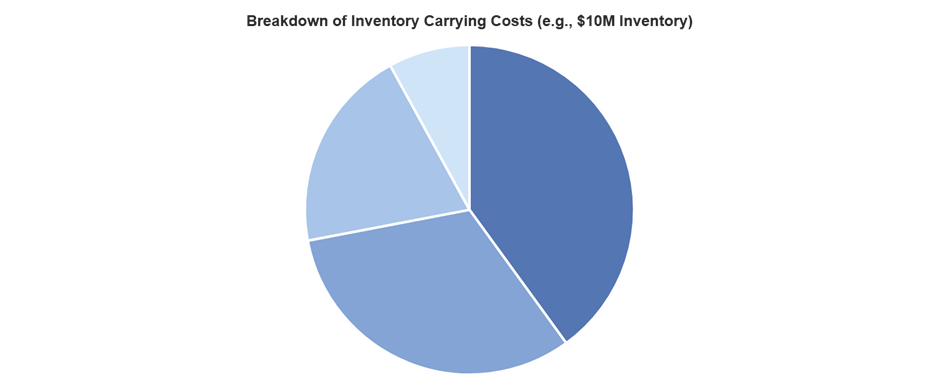
Figure 1: Typical components of annual inventory carrying cost, as a percentage of inventory value (e.g., for a $10 million inventory, total carrying cost ≈ $2.5 million per year). Capital costs (interest or cost of tied-up funds) are usually the largest portion of the “hidden” costs of holding inventory.
For metal distributors, these carrying costs can significantly erode profitability. Every dollar spent on maintaining excess stock is a dollar not spent on customer acquisition, equipment upgrades, or other growth initiatives. Moreover, high inventory ties up working capital that could buffer against market downturns or be used to negotiate better purchasing terms. In essence, inefficient inventory is a form of operational waste – it’s money “stuck” on the shelf.
The Traditional Mindset vs. Modern Reality: Historically, many distributors kept large inventories as a buffer to ensure product availability. The mindset was “you can’t sell what you don’t have,” and stockouts were seen as the ultimate risk. But carrying massive stock “just in case” comes at a steep cost, and as data shows, a lot of that inventory often sits idle. In fact, it’s common to find that 20% of SKUs account for 80% of sales (the classic Pareto principle) – meaning a large portion of inventory generates minimal revenue. The rest is “safety stock” for rare emergencies or obsolete items awaiting a buyer. In the modern era, leading distributors are rethinking this approach, realizing that with better data and supply chain practices, they can operate leaner without letting customers down.
The Opportunity: By systematically identifying and eliminating excess inventory, companies can reduce those hidden carrying costs proportionally. If you reduce average inventory by 20%, you can potentially free up 20% of that $2.5M carrying cost – about $500,000 annually in our example. That freed capital can be reallocated to more productive uses (or drop straight to the bottom line as profit). Companies that optimize inventory also report better order responsiveness and fewer write-offs, because their stock better matches actual demand. In short, tackling inventory overhead is often one of the fastest ways to improve financial performance in distribution. The following sections outline how to achieve these gains.
Strategies to Reduce Capital Costs through Inventory Optimization
Facing the challenge of high inventory costs, metal distributors are adopting a combination of process improvements and technology. Below are three core strategies, each building on industry best practices and often enabled by modern software:
1. Data-Driven Forecasting & Demand Planning: “You can’t manage what you can’t predict.” The first step is to sharpen your demand forecasting. Inaccurate forecasts lead directly to surplus stock (if you overestimate demand) or stockouts (if you underestimate). By analyzing historical sales, seasonality, and customer buying patterns, you can project needs more accurately and shrink the “just in case” inventory buffers. Advanced forecasting tools, including those with AI/ML, can factor in trends and even external variables (like market indicators or customer-specific forecasts) to fine-tune your demand plans. Improved forecast accuracy means you order closer to what you actually need, which reduces overstock and the associated carrying costs.
Tip: Integrate Sales & Operations Planning (S&OP) processes. Regularly review forecasts with sales, purchasing, and finance teams to align inventory targets with current market conditions. This cross-functional approach ensures everyone agrees on the balance between inventory investment and service levels, helping avoid unnecessary stock build-up. Many leading distributors also incorporate “forecast consumption” techniques – dynamically adjusting inventory targets as real orders replace forecasted demand, so you’re not stuck holding inventory for forecasts that didn’t materialize.
2. Optimized Inventory Policies (“Lean Inventory”): Leading firms are revisiting the policies that govern how inventory is managed:
- Segmentation & Rightsizing: Not all products should be treated equally. Categorize inventory into A/B/C groups by sales volume or strategic importance. A-items (high runners) might merit higher safety stocks and frequent reorders, while C-items can be kept minimal or even moved to special-order status. One distributor found that halving the stock of their bottom 30% slow-moving SKUs had no negative impact on sales, but significantly cut carrying costs – those items were rarely selling anyway.
- Just-In-Time (JIT) and Supplier Collaboration: Where feasible, coordinate closely with suppliers to receive smaller, more frequent shipments. This reduces the time you need to hold inventory. Some metal service centers partner with mills or processors on vendor-managed inventory (VMI), where suppliers monitor usage and replenish stock as needed. Others establish clear reorder triggers so that inventory is replenished at the last responsible moment.
- Dynamic Stock Targets: Use data to set optimal reorder points and safety stock levels. Instead of static rules (like “maintain 3 months of supply for all items”), advanced methods calculate safety stock based on variability and lead times for each SKU. This often reveals that you can safely reduce inventory on many items without hurting availability. One industrial parts supplier used an algorithmic approach to safety stock and was able to reduce inventory by over 15% with zero increase in stockouts, because their previous rules were overly conservative.
- Regular Inventory Audits & Rationalization: Periodically review your catalog for dead stock and slow movers. Materials that haven’t turned in, say, 12 months could be liquidated or produced on-demand instead of being kept on hand. A SKU rationalization project at a multi-site distributor uncovered $10+ million in slow-moving inventory that could be sold off or not restocked, immediately reducing carrying costs and freeing space for more profitable items.
3. Leverage Specialized Inventory Optimization Technology: Modern problems often demand modern solutions. Traditional ERPs or spreadsheets are often inadequate for the complexities of metal inventory (like varying dimensions, alloys, and remnants). Enter inventory optimization software – particularly solutions tailored to the metals industry, such as Micro Metal’s platform. These tools provide several capabilities that drive cost reduction:
- Real-Time Visibility: A centralized, real-time view of stock across all warehouses and yards. This enables transfer of excess material to where it’s needed instead of buying more, and prevents over-ordering by making overall stock levels transparent.
- Advanced Analytics & Alerts: The software monitors trends and sends alerts when inventory levels drift out of optimal range – for example, if certain SKUs are overstocked relative to demand. Analytics dashboards track KPIs like inventory turnover, aging stock, and service level, helping managers pinpoint opportunities to trim inventory and measure progress.
- Predictive Forecasting & Auto-Replenishment: Modern systems use AI/ML algorithms to continuously improve demand forecasts, accounting for patterns that might be missed by manual planning. They can auto-generate purchase orders or production schedules that meet demand with less slack. This level of automation ensures you order the right quantities at the right time, reducing human guesswork (and the tendency to overstock “just in case”).
- Metal-Specific Features: Because metals have unique attributes (grade, dimensions, heat numbers, etc.), a generic inventory system might not capture inventory nuances, leading to accidental overstock or misallocation. A specialized system like Micro Metal Software tracks these attributes natively – from coil lengths and remnants to lot certification – giving you confidence to run leaner inventories. It can also handle multi-location coordination (e.g., suggesting transferring surplus from one warehouse to fulfill demand at another), which avoids unnecessary new purchases.
- Results: Companies that deploy such advanced tools often see rapid payback. For example, an industrial manufacturer implemented an AI-driven inventory system across multiple warehouses and eliminated stockouts while achieving over a 20% reduction in carrying costs within a year. The investment in technology was recouped in mere months through the savings on inventory and improved sales (thanks to better product availability and fewer lost orders).
Proof in Practice – Case Highlights: Forward-thinking companies in the metals and manufacturing space have already demonstrated the benefits of these strategies:
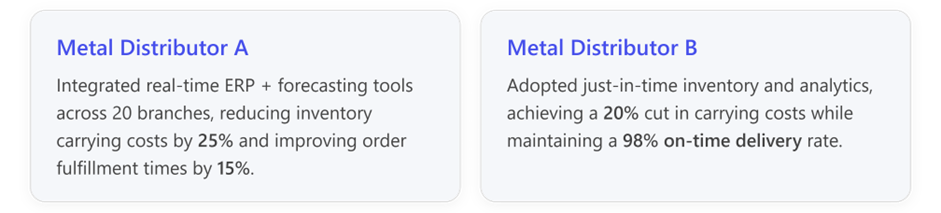
(In both cases, note that customer service was not compromised by reducing inventory – in fact, performance improved thanks to better alignment of stock with actual demand.)
These examples mirror findings across the industry: companies that optimize inventory can save 15–25% in carrying costs, often releasing millions in cash and strengthening their service capabilities at the same time. The figure below illustrates an example outcome reported after an inventory optimization initiative (before-and-after comparison):
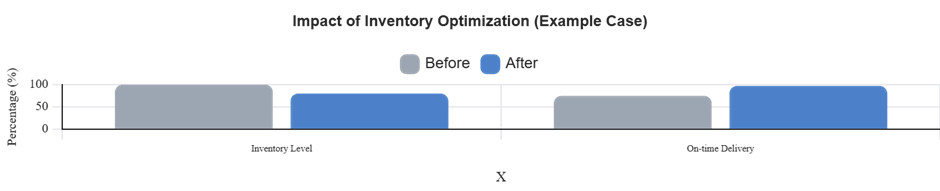
Figure 2: Impact of an inventory optimization program on one distributor’s performance. By reducing average inventory to ~80% of previous levels, the company cut carrying costs significantly, while on-time delivery rates improved from 75% to 97%, thanks to better demand fulfillment.
Conclusion & Next Steps
For metal distributors, reducing inventory is one of the most effective ways to cut costs and unlock cash in today’s competitive environment. By tackling the often-overlooked carrying costs, companies can:
- Improve cash flow: Less money tied up in stock means more liquidity to invest in other areas (new equipment, acquisitions, debt reduction, etc.).
- Increase profit margins: Lower holding costs translate directly into higher profitability on each sale.
- Maintain or improve service levels: When done right, inventory optimization ensures the most important items are always in stock, potentially increasing fill rates even as total inventory goes down.
- Enhance agility: A leaner inventory is easier to adjust in response to market changes (e.g., sudden shifts in demand or price). Companies aren’t caught with huge piles of slow-moving stock during downturns and can react faster to new opportunities.
By following the strategies outlined – from improving forecasts to leveraging metal-specific inventory software – metal distributors can transform inventory management from a cost center into a strategic advantage. The journey to optimal inventory is both a financial transformation (freeing up capital, boosting ROI) and an operational one (streamlining processes for efficiency).
Now is the time to act: with pressure on margins and capital, optimizing inventory is one of the most controllable levers management can pull to improve performance. Many peers have already begun this journey, reaping substantial savings. The tools and techniques are available and proven.
Micro Metal’s Role: At Micro Metal, we specialize in inventory optimization for metal distributors. Our platform is designed to provide the real-time visibility, advanced forecasting, and smart automation described in this paper – tailored specifically to the metals industry’s needs. We’ve helped companies achieve the kind of results outlined here, from cost reductions to service improvements.
If you’re ready to explore how these best practices can apply to your organization, we invite you to connect with our team for a personalized assessment or a demo of our inventory optimization solution. By taking action now, you can reduce the capital costs of your inventory and turn those savings into a strategic investment in your company’s future.
Condensed Executive Brief: “Reducing Capital Costs in Metal Distribution”
Challenge: Excess inventory is a hidden cash drain. Metal distributors commonly spend 20–30% of their inventory’s value per year on carrying costs (financing, storage, insurance, etc.). For a $10M inventory, that’s roughly $2–3M annually in “invisible” costs, squeezing margins and tying up capital.
Insight: Optimizing inventory management can slash these costs. Leading distributors have reduced inventory-related costs by 15–25% through data-driven forecasting, lean inventory practices, and specialized software. Crucially, they maintain high customer service (≈98% on-time delivery) even with leaner stock.
Solution Strategies:
- Better Forecasting: Use advanced analytics or AI to predict demand more accurately. Avoid overstocking by syncing purchases with true demand, thereby lowering safety stock buffers without risking stockouts.
- Lean Inventory Policies: Implement Just-in-Time where feasible, classify and manage A/B/C inventory differently, and eliminate “dead stock.” Collaborate with suppliers (e.g., vendor-managed inventory) to enable smaller, more frequent replenishments of metal stock.
- Specialized Inventory Systems: Leverage technology designed for metal distribution – solutions that offer real-time visibility across all locations, automated reorder point optimization, and detailed tracking of metal attributes (grade, dimensions, heat numbers). These systems provide the control needed to run leaner inventories without sacrificing availability.
Proof Point: In one case, a metal distributor cut carrying costs by 25% after implementing an inventory optimization program, saving $500K+ in the first year and improving delivery speed by 15%. Another reduced excess stock by 20% while sustaining a 98% fill rate. Such results demonstrate that better inventory management directly boosts profit and frees up cash for growth.

Recent Posts
About Micro
Micro Metal Software provides powerful ERP, inventory management, ecommerce, and operations software built specifically for the metal industry. Designed for steel service centers, metal distributors, processors, and fabricators, our platform helps companies manage inventory, purchasing, sales, production, quoting, order fulfillment, and online customer portals from one connected system. With industry-specific tools for metal stock control, traceability, pricing, and distribution workflows, Micro Metal Software helps metal businesses streamline operations, improve visibility, reduce manual work, and scale with confidence.
Learn More